

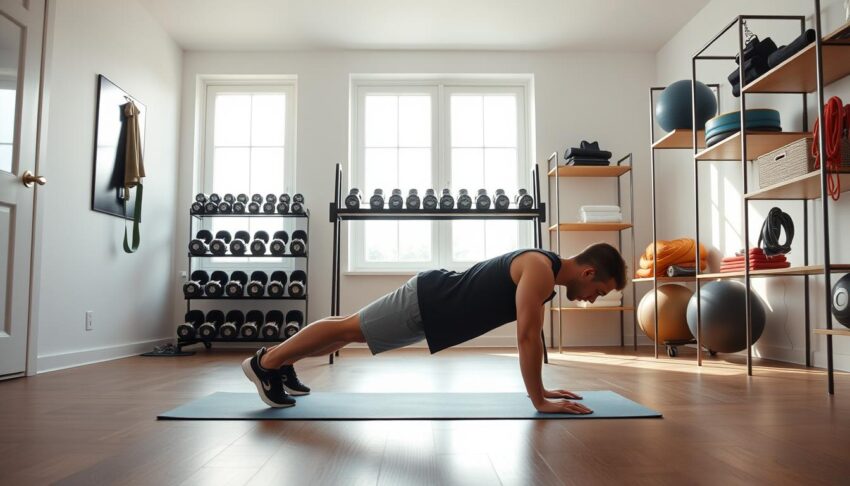
Start strong today with short, practical sessions you can do without equipment. Bodyweight moves like bridges, chair squats, knee pushups, lunges and planks build strength, boost aerobic fitness, and help manage fat.
This guide takes you from beginner circuits to intermediate and advanced progressions, so you always know the next step toward your goal. Each plan includes clear set and rep targets, pacing tips, and form cues to keep sessions safe and effective.
Short, consistent sessions add up: aim for the Physical Activity Guidelines of 150 minutes of moderate activity or 75 minutes of vigorous effort each week. You can stack three 20-minute sessions or spread movement across the week to hit that target.
Find minimal-equipment alternatives using dumbbells or a bench, plus a simple weekly schedule and practical nutrition advice to support recovery and gains. Start where you are, pick a routine that matches your level, and build steady progress with good technique.
Key Takeaways
- Bodyweight training builds strength, muscle, and aerobic fitness with no gear.
- Follow clear sets, reps, and pacing to train with purpose.
- Aim for 150 minutes of moderate activity weekly; short sessions work.
- Progress by increasing volume and maintaining proper form.
- Minimal equipment options and simple nutrition tips support results.
Start here: How to set up a safe, effective at-home workout space
Set up a clutter-free corner and you can begin short, focused sessions in minutes. A clear spot about the size of a yoga mat gives you room to lunge, step back, and move without hitting furniture.
Simple gear and timing make this easy. Keep a phone or watch as a timer and plan 30–60 seconds of rest between drills. That keeps sessions to about 15–20 minutes while protecting form and pace.
“Start with a small space and consistent time; habits grow faster than you think.”
- Choose flat, non-slip flooring and consider a mat for floor work to protect joints.
- Position a chair or bench against a wall and place any small equipment where it won’t wobble.
- Use a mirror or record a few reps to check alignment and maintain proper form.
- Set a quick pre-session checklist — timer, water, and a notes app to track progress.
These small steps create a safer, more effective way to train at home. Over time, consistent setup habits save time and reduce injury risk.
Home workout routines: What to expect and how often per week
Design your week around manageable blocks of training that add up to the recommended minutes. Adults should aim for at least 150 minutes of moderate activity per week plus two sessions of strength work.

Practical split: stack three to five short sessions of 20–30 minutes across the week to hit the 150-minute target. Short sessions make consistency easier and keep momentum high.
The 150-minute weekly target and how to split sessions at home
Plan 3–5 sessions per week. A typical beginner circuit runs 15–20 minutes and fits neatly into a busy day. Track total minutes each week to confirm progress.
Rest intervals, sets, reps, and time under tension basics
Expect 2 sets of 10–15 reps per exercise for beginners. Keep rest between moves at 30–60 seconds so the heart rate stays elevated while form stays sharp.
“Use slow, controlled tempo and brief pauses at the hardest point to get more strength from each rep.”
- Progression: add a third set or a few extra reps as you adapt.
- Balance: alternate full-body days or simple splits to hit legs, push, pull, and core.
- Track: log sets, reps, and total minutes so your program remains measurable.
Beginner bodyweight routine: Full-body circuit you can do today
Follow this easy full-body plan to build strength, mobility, and exercise confidence. It fits a busy day and teaches safe mechanics for each move. Complete the circuit twice to hit the target time and intensity.
Warm-up and movement prep for proper form
Begin with 3–5 minutes of gentle movement: march in place, arm circles, and hip hinges. Then do a few glute bridges and shoulder taps to groove the pattern for the main exercises.
Do-this circuit
Perform the following bodyweight exercises in order: Bridge, Chair Squat, Knee Pushup, Stationary Lunge, Forearm Plank (or plank-to-downward dog), Bird Dog, Side-lying Hip Abduction, and Bicycle Crunch.
Prescription: sets, reps, seconds, and rest
Plan: complete 2 sets of 10–15 reps per exercise. Rest 30–60 seconds between moves to keep the pace steady. Hold planks for 30–45 seconds.
“Pause briefly at the top of each bridge to feel a strong squeeze and protect your back.”
Why this works: Bridges activate the posterior chain. Chair squats teach hip and knee alignment. Knee pushups build pressing strength while protecting shoulders. Stationary lunges develop leg strength and balance.
Log sets and reps each day so you can add a rep, slow your lowering phase by a few seconds, or progress when the circuit feels easy.
Level up: Intermediate at-home workouts for strength and muscle
Move beyond basics by choosing structured progressions that build real strength and muscle. This phase mixes traditional sets and timed rounds so you can add volume without losing form.
Choose either 2 sets of 10–15 reps per exercise with about 60 seconds rest, or try 45–60 second timed rounds and repeat the circuit twice. Both approaches increase training density while keeping technique crisp.
Timed rounds vs. reps: progressing volume without sacrificing form
Timed rounds force steady pacing and cardio carryover. Reps-based sets let you chase strict strength gains. Pick one format per session so you track progress clearly.
“Add one or two reps each session, or add 5–10 seconds to a station — small wins compound into real progress.”
Sample routine
Try this circuit for a solid day: Squats, Standard Pushups, Forward and Backward Traveling Lunges, Pike Pushups, Superman, then a core finisher like Plank with Alternating Leg Lift and Dead Bug. Perform 2 sets of 10–15 reps or 1 minute per station, twice through.
- Squats: full depth, steady tempo to target legs and hip control.
- Pushups: neutral neck and 45° elbows to protect shoulders.
- Traveling lunges for unilateral balance and stronger leg drive.
- Pike pushups and Superman to target shoulders and the posterior chain.
Progress by adding a rep, adding seconds to rounds, or adding a third set for one movement that feels solid. Keep rest honest and logs updated so your level climbs without sacrificing safety.
Advanced progressions when bodyweight feels easy
Step up your training by adding unilateral and explosive moves that expose weak links. These progressions build more overall strength and resilience in the legs and back without gear.
Sample plan: perform 2 sets of 10–15 reps per exercise with 30–60 seconds rest, or do one set of each and repeat after 1–2 minutes. Focus on quality movement over speed.
Plyometric and unilateral upgrades
- Single-Leg Bridge with Leg Extended — balances hips and trains each leg evenly.
- One-Legged Pushup and Elevated Pike Pushups — load one side and shift more into the shoulders.
- Jumping Lunges and Kneeling Squat with Jump — add power while keeping landings soft.
Core challenges and stability
Include Hollow Hold to Jackknife and One-Leg Forearm Plank Holds to tax the midline. Side Plank with Hip Abduction strengthens lateral chains that protect knees and hips.
Programming tips
Use 2–3 sets of 8–12 reps for strength-endurance or 30–40 seconds per station for time under tension. Rotate power moves early in the session and save core finishers for last.
“Log your sets and reps so weekly progress becomes visible — more reps, longer holds, or higher elevation without breaking form.”
Minimal-equipment options: Dumbbells and a bench for at-home strength training
If you have adjustable dumbbells and a sturdy bench, you can turn a spare corner into a powerful strength zone.

Why this matters: a bench plus dumbbells gives you pressing, pulling, and single-leg options that mimic gym lifts. That extends the value of each session and speeds progress in strength training.
Lower body and push-pull splits with adjustable dumbbells
Organize three focused days: legs & shoulders, chest & back, then arms & core. Keep rest at 60–90 seconds and choose a weight that leaves one or two clean reps in reserve.
Example days and set/rep schemes
- Day 1 — Legs, Shoulders, Abs: Dumbbell Squats 3×6–8; Standing Shoulder Press 3×6–8; Lunges 2×8–10/leg; Upright Rows 2×8–10; Romanian Deadlifts 2×6–8; Lateral Raises 3×8–10; Seated Calf Raises 4×10–12; Crunches 3×10–12.
- Day 2 — Chest, Back: Dumbbell Bench Press 3×6–8; Bent-over Rows 3×6–8; Dumbbell Fly 3×8–10; One-arm Rows 3×6–8; Pushups 3×10–12; Pullovers 3×10–12.
- Day 3 — Arms, Abs: Alternating Curls 3×8–10/arm; Overhead Triceps Extensions 3×8–10; Seated Curls 2×10–12; Bench Dips 2×10–12; Kickbacks 3×8–10/arm; Planks 3x30s.
“Use the bench to vary angles — incline presses, chest-supported rows, and split squats add useful variety.”
Progression tip: add a rep, a small weight increment, or one extra set over weeks and log each session so gains stay visible and steady.
Weekly scheduling made simple: Build your routine by day
Plan your week so each session has a clear purpose and you never guess what to do on training day.
Beginner: three full-body days with rest and active recovery
For beginners, pick three nonconsecutive days per week — for example, Monday, Wednesday, and Friday.
Keep sessions to 20–30 minutes to hit the 150 minutes target without burnout. Use active recovery on off-days, like easy walks or mobility flows, to boost blood flow and aid recovery.
Intermediate: upper/lower split across four days
Move to a four-day program with two upper days and two lower days each week.
On upper days, lead with presses and rows, then add shoulders, arms, and core. Aim for 2–4 sets per exercise and pick reps depending on your goal.
On lower days, prioritize squats or hip hinges, then lunges, hamstrings, calves, and abs. Keep rest steady so the session finishes on time and quality stays high.
Advanced: push-pull-legs pattern and when to add supersets
Advanced trainees can use a push-pull-legs rotation twice per week for high frequency and growth.
Consider adding logical supersets to save time while keeping form sharp — pair noncompeting movements like presses with single-leg work.
“Distribute your sets and reps evenly across the week so each muscle group gets work and recovery.”
- Template tip: keep a standing weekly plan with exercise names, sets reps, and rest windows.
- Density option: pair noncompeting moves or reduce rest slightly when time is tight, but protect good reps.
- Weekly review: check total minutes, log progress, and set targets for the coming week.
Form first: Technique cues to protect joints and maximize results
Prioritizing technique keeps your body safe and makes each rep more effective. Good form builds strength while reducing pain and injury risk.

Quick cues to follow:
- Squats: root your feet, brace the core, and sit back so hips and glutes take the load. Keep knees tracking over mid-foot and a neutral spine to protect the back.
- Pushups: hands under shoulders, ribs tucked, and elbows about 45° to cut shoulder stress and make it a full-body exercise.
- Lunges: step far enough so the front thigh becomes parallel to the floor. Lower with control and stop any inward knee collapse.
During planks, squeeze glutes and quads. Keep a straight line from head to heels and shorten holds if the lower back sags. Control speed: use a 2–3 second lowering phase and a steady ascent.
“Film a set sometimes; small cues like ‘knees out,’ ‘brace,’ and ‘long spine’ improve every session.”
Tip: use 30–60 seconds of rest between stations to reset your brace and keep crisp technique for the next sets reps.
Nutrition and weight loss essentials to support your training
Match your plate to your plan: calories, protein, and timing guide whether you lose fat or build muscle. Nutrition drives recovery and the results you see from short sessions and a 150-minute target each week.
Protein, calories, and timing to match intensity
Align calories with your goal. A modest deficit supports weight loss while keeping energy for training. If your aim is to build muscle, a slight surplus and steady protein help.
- Protein across meals: include lean meats, dairy, eggs, or plant proteins so the body repairs after each home workout.
- Snack timing: a protein-rich snack 60–90 minutes before or after sessions can help, but total daily protein matters most.
- Hydration: sip water throughout the day and add electrolytes for longer, sweatier workouts.
Why you can’t spot-reduce belly fat and how to drive fat loss
You cannot spot-reduce the belly; the body loses fat systemically. A steady calorie deficit plus consistent activity is what creates visible weight loss.
“Consistent minutes of activity each week and thoughtful calorie control beat miracle promises every time.”
Practical checklist:
- Track average weekly body weight, tape measures, and photos to spot real change beyond daily fluctuation.
- Build grocery lists around minimally processed foods—vegetables, whole grains, quality protein, and healthy fats.
- Use simple meal templates: protein + fiber + smart carbs + healthy fat to make adherence easier.
Reassess every 2–4 weeks: tighten portions slightly, add a few minutes to a session, or add a walk on rest days if progress stalls. Simple tweaks help the plan keep working toward your weight and performance goals.
Conclusion
Strong, consistent steps make this a clear way to move from a brief beginner circuit to advanced progressions. Pick a plan you enjoy and log your sets and reps so progress stays visible.
You can complete effective sessions in 15–20 minutes. Use bodyweight exercises when time is tight, or add dumbbells and a bench for presses, squats, rows, and RDLs to expand options and weight choices.
Aim for ~150 minutes weekly and treat each day as a chance to build strength with good form. If you miss a day, keep it simple and return the next day. Small, steady changes are the best way to long-term progress.